Tapo vs Tapo
We compare the Tapo and the Tapo across every dimension that matters - our scores, the key specs, and how each performs on the things you will actually notice day to day.

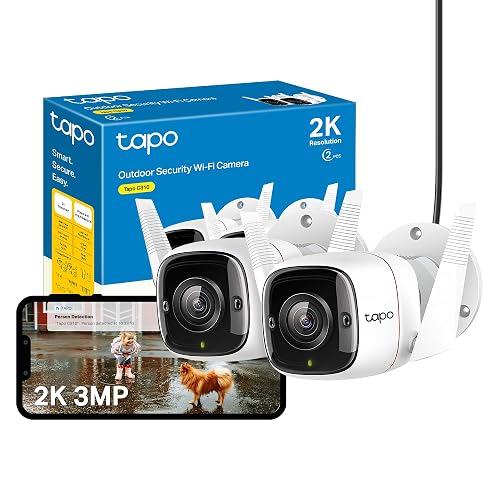
At a glance
| Tapo | Tapo | |
|---|---|---|
| Our score | 9.4/10 | 9.3/10 |
| Best for | Keeping an eye on your home, indoors or out, without a monthly fee | Keeping an eye on your home, indoors or out, without a monthly fee |
| Not ideal for | Buyers who want fully managed off-site cloud storage as standard | Buyers who want fully managed off-site cloud storage as standard |
| Brand | Tapo | Tapo |
Video Quality and Resolution
Tapo
Even without lab tests, this security camera's stated "2K, 4MP" resolution offers a clear baseline for video clarity, sitting above basic 1080p-class cameras and helping capture more visible detail at typical outdoor viewing distances. In use, the extra pixel count can make clips saved to the local SD card look sharper when zooming in, as finer edges and smaller shapes are more easily resolved. Actual sharpness still depends on the scene's lighting and the distance to the subject, as well as how much the pan and tilt movement changes framing. Overall, video detail should be solid outdoors, but expectations should remain realistic.
Tapo
With 2K video specified in the product title, this security camera is positioned as a step up from lower-resolution outdoor cameras, aiming for clearer detail in everyday scenes. Higher resolution supports identification of faces, vehicles, and package shapes when reviewing clips on a phone, particularly when cropping is needed. The video feed is also supported by AI detection, which can reduce the need to watch every motion event.
Day and Night Vision
Tapo
Night performance matters most for outdoor cameras, and the Tapo is designed to provide colour night vision as well as daytime recording. Its Starlight colour night vision helps keep scenes viewable when light drops, and it supports continuous monitoring through the day. For night use, it relies on the same 2K, 4MP video capture, so details stay consistent when switching between lighting conditions. Colour at night typically depends on available illumination, so darker areas may look less vivid than at dusk. Overall, the camera still offers outdoor-ready night viewing for common garden paths and driveways.
Tapo
Day and night performance matters for any outdoor camera. The Tapo includes infrared night vision for low-light viewing, and it supports AI detection to support more accurate motion and person alerts in both lighting levels. In daylight, the camera captures outdoor scenes at 2K resolution for clearer faces and details than lower-resolution options. After dark, infrared illumination helps it continue recording when ambient light drops, but visibility can still be affected by distance, fog, and reflective surfaces. Overall, infrared night vision is a key strength, with results dependent on conditions.
Power and Placement
Tapo
Power and placement for the security camera depend on whether it can be wired or powered where the camera is needed, and on how much outdoor coverage is possible. The camera is designed for outdoor use with IP66 weatherproofing, so it can be placed under typical UK eaves or sheltered wall areas. Since it supports pan and tilt with 360° vision motion tracking, placement should consider the viewing angle first, then access to a power source. If wiring is inconvenient, placement is limited to areas where power can reach reliably, otherwise coverage may be reduced. For best results, mount at a practical height and aim the lens towards key entry paths.
Tapo
Power and placement are usually where outdoor wired cameras either fit well or become a hassle. The security camera is a wired outdoor model, so it requires a constant power feed, which makes early planning important. It is rated IP66 for weatherproofing, so it can be mounted on walls or under eaves where rain and dust are expected. Placement should keep the lens level, avoid strong backlight from doors, and aim for clear views of walk paths. If cables cannot be routed neatly, installation becomes more involved, and later repositioning is harder.
Storage and Subscription
Tapo
For the Tapo, storage is handled via local SD storage. That means recordings can be saved on the camera itself without a monthly subscription, avoiding ongoing subscription costs for recording. Storage capacity depends on the SD card size, so users need to plan for overwriting when space runs out. When pairing the camera, confirm recording settings align with the intended storage approach, since storage is tied to the capacity of the inserted SD card.
Tapo
For local storage, the Tapo is set up to record onto local SD cards, so there is no monthly subscription fee for saving footage. Instead of paying for cloud space, the owner relies on onboard storage. With local recording, file capacity depends on the SD card size, because the storage can fill up and overwrite older clips when configured. It is also important to check that an SD card is inserted and functioning, as missed setup can result in gaps in saved video. This approach suits people who want lower ongoing costs, but it does require occasional SD card management.
Smart Detection and Alerts
Tapo
Smart detection and alerts on the security camera are designed to reduce false alarms by combining motion detection with person detection, alongside AI detection. This means the camera can classify events more clearly than a basic motion alert setup and then prioritise notifications when a person is likely to be present. The camera supports pan and tilt with 360° vision, which helps it keep a moving target in view and can improve the relevance of alerts. Alerts work best alongside local SD recording. Setup choices affect the kinds of events the camera detects and how reliably it triggers alerts.
Tapo
With local SD storage covering where footage is saved without a monthly subscription, the security camera's smart detection determines when that footage gets recorded and how alerts are handled. It supports AI detection with motion and person detection, so alerts and recordings can be triggered by relevant activity rather than every movement. When a person is detected, the camera records to the local card and sends an alert, which helps reduce missed moments. Setup is straightforward, but some trial-and-adjustment may be needed to achieve the best results.
Two-Way Audio and Siren
Tapo
Two-way audio on the Tapo C520WS lets a person speak through the camera, so someone outside can hear messages without needing to open a door. This is useful for deliveries, visitors, or checking on a porch during motion events. During motion events, the camera's pan and tilt can help frame the area, and the built-in siren can be used to deter unwanted visitors if activated. Audio performance depends on ambient noise, distance and microphone placement, so clear replies may require close speaking.
Tapo
Two-way audio on the Tapo C310P2 lets users speak through the camera, enabling communication with someone outside without opening a door. It can also assist when checking what triggered a motion alert, since the camera supports listen-and-respond during incidents rather than relying on video alone. Recording storage is local via an SD card.
App and Setup
Tapo
Setting up the Tapo is where the built-in siren and two-way audio become part of everyday use, because the camera must be linked to the security camera app before live viewing and notifications are available. Buyers should install the Tapo app, then add the camera by following the on-screen pairing prompts. During setup, the camera should be placed within Wi-Fi range, since signal strength can affect reliability. After pairing, buyers can configure person and motion alerts, activate AI detection, and choose where events are stored on the local SD card, with no monthly fee. If the camera fails to connect, buyers should recheck the power and network details.
Tapo
Setup picks up after the communication features, since the next step is getting the wired outdoor camera connected and ready for recording. The Tapo is added in the security camera app on a phone, which guides users through powering on the camera and confirming signal strength for a reliable connection. After pairing, the app enables review of motion and person detection alerts and lets users choose how clips are saved to the included local SD storage, with no monthly fee. If the connection drops, rechecking Wi-Fi and app permissions typically resolves delays.
Who Is This Security Camera For?
Tapo
The security camera pan/tilt outdoor security camera suits homeowners or small property managers wanting 2K (4MP) video coverage outside. It is a good fit when a wider view that can move and track motion is required. For night use, it supports colour night vision for clearer identification in low light. This camera can feel limited for anyone expecting fully specified features beyond the stated IP66 weatherproofing, plus Alexa and Google compatibility, where other capabilities are not described.
Tapo
The Tapo is a strong choice for people who want an outdoor security camera with no monthly fee, while still benefiting from AI alerts such as motion and person detection. It suits households that prefer wired power, since installation depends on a cable run, and it is designed for outdoor use with IP66 weatherproofing. It is also aimed at buyers who want infrared night vision and two-way audio, enabling activity checks after dark and communication with visitors. For smart-home integration, it works with Alexa and Google to fit into existing routines.
Tapo: pros
- 2K video
- Local SD storage - no subscription needed to record
- Colour night vision
- Pan and tilt to follow movement
Cons
- Cloud backup and longer history still need an optional paid plan
- As a Wi-Fi camera, reliability depends on your home wireless signal at the mounting spot
- Wired power means it must be mounted near a socket or hardwired
Tapo: pros
- 2K video
- Local SD storage - no subscription needed to record
- Infrared night vision
- Wired
- Two-way audio to talk and listen
Cons
- Cloud backup and longer history still need an optional paid plan
- As a Wi-Fi camera, reliability depends on your home wireless signal at the mounting spot
- Wired power means it must be mounted near a socket or hardwired
Our verdict
Our pick is the Tapo (our score 9.4/10) - A practical security camera (2K, no-subscription storage) for home security, with phone alerts and colour night vision. The Tapo is still worth it if it is cheaper when you check, or if it better matches your specific needs.